

Research Updates

Here at Bigger Better Brains we believe that through educating yourself, you can then educate and affect positive change in your community.
With all of the research in the field of neuromusical science, our BBB Research section serves as a content hub for you. We regularly share findings and break down the latest research to educate and inspire discussion. We hope you enjoy this page on our website and share BBB news with your colleagues, parents and students.

A couple of reasons why every child should have access to music education
In this study, released by Florida International University, they found that group music classes affected overall competence, confidence, caring, character and connection.

What is working memory and how might music learning help?
This article is a great explanation of working memory and the different ways it is affected by disorders such as dyslexia, auditory processing disorder and ADHD.
Background music – good or bad for productivity?
As always it is all about context and what you trying the measure. This study found that background music for musicians leads to greater productivity, than non-musicians.

Music learning can change the educational life for disadvantaged students
Music has been used as an intervention around the world to help students, and inevitably whole communities, who are living in challenging circumstances.

The chicken and working memory egg
Musicians have been found to have a higher capacity for something called speech-in-noise. This is the ability to hear and understand speech in a noisy environment.

Is music talent set or grown?
Our traditional ideas about musical talent are being challenged by neuromusical research. Through studying musicians Neuroscientists and psychologists are working with a theory that we are born with predispositions for many things.

Effective working memory leads to effective and efficient learning
Working memory is our temporary storage unit for information. It is the folder we put our daily timetable in, what we need to take with us to work or school.

I succeeded as an entrepreneur because of my music degree
“I succeeded as an entrepreneur not despite the fact that I had a music degree, but precisely because of it.” This statement came from Panos Panay, the founding managing director of the Institute for Creative Entrepreneurship at Berklee College of Music.

Do teenagers know best when it comes to using music to enhance study?
Here is a question we get from parents all the time – should I let my teenager listen to music while they study?
Strings for the win!
This study followed the students for two years and measured how the different types of music learning impacted on several executive function skills.

Musical training linked to improved attention and working memory
“Musical training can improve attention and working memory, which are executive functions that are important for daily life and are correlated with general better outcomes during lifespan.”

This is not a violin…
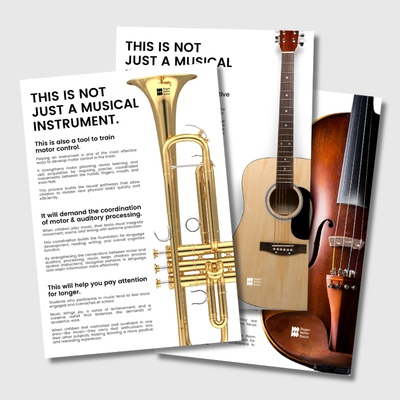
On Jan 3, 2023, Bigger Better Brains and I started a campaign we called “This is a not a…” campaign. At the essence of the campaign is the idea that music learning is not just learning music, but learning how to learn.



The evidence behind everything you teach, in one book
From Dr Anita Collins, music educator and creator of the TED-Ed video watched 17+ million times, translating the world's neuroscience research into the case for music education and the strategies to bring it into your teaching.
You already know music changes your students. The Music Advantage gives you the research that proves it. Because Anita explains the science through real-life stories, it reads like a good conversation rather than a textbook. Use it to advocate for your program, win over parents and leadership, and sharpen what you do in the classroom.
WHAT YOU GET
The complete book, 260 pages
Easy to read: the neuroscience explained through real classroom and family stories
Practical strategies you can apply across any age you teach, from birth to the teenage years
CHOOSE YOUR EDITION
Global edition: for readers outside the US
US edition: US terminology and examples
Signed copy: personally signed by Dr Anita Collins [while stocks last]
HOW TEACHERS USE IT
Advocacy: make the evidence-based case to school leadership for funding and keeping your program
Parent conversations: answer "is it really worth it?" with authority at enrolment and parent nights
In the classroom: practical strategies, from clapping to help a struggling reader, to ensemble play for concentration and social skills
Professional development: deepen your grasp of the "why" behind your teaching, or read it as a department
WHY IT WORKS
Written by Dr Anita Collins and grounded in research from leading neuromusical scientists worldwide, so when you make the case for music you are standing on the science, not opinion. And the real-life stories mean you will actually enjoy reading it.
"This book is my bible. I have so many highlights and pages flagged that I can use with parents and for quotes in emails." Kirsten, Music Teacher.
COMMON QUESTIONS
Which edition should I choose? Global for outside the US, US edition for US spelling and examples.
Is it a hard read? Not at all. Anita uses real-life stories to make the science clear and enjoyable.
What ages does it cover? Birth to the 18 years, useful whatever level you teach.
Add to cart NOW. Put the evidence for music behind your program today.
KEEP THE ADVOCACY GOING
BBB+ gives music teachers everything they need to make the case for music all year round:
A new advocacy toolkit every month
A library of 500+ tools and resources
Exclusive student exercises and advocacy materials
Member discounts
See what members get HERE