

Research Updates

Here at Bigger Better Brains we believe that through educating yourself, you can then educate and affect positive change in your community.
With all of the research in the field of neuromusical science, our BBB Research section serves as a content hub for you. We regularly share findings and break down the latest research to educate and inspire discussion. We hope you enjoy this page on our website and share BBB news with your colleagues, parents and students.

Singing is fundamental to our biological makeup
This is a brilliant article worth a full read, but here are some highlights for you from one of BBBs favourite researchers Professor Sarah Wilson from the University of Melbourne.

Can music help people with Parkinson’s?
Music therapy and music learning are having a profound impact on the life and rehabilitation of people suffering from Parkinson’s disease. It is important to understand the difference between music therapy and music learning because sometimes they either look very similar, or one leads seamlessly into the other.

$20 million is a serious investment in music as medicine
It has been widely publicised that the National Institute of Health (NIH) in the U.S. has just awarded the Sound Health Initiative $20 million over the next 5 years to look into the health and learning benefits of music and music learning.

Singing at work = better job performance
Imagine having a singing group at your work. Imagine starting the day with a song with your colleagues. What would your work culture feel like and how would you feel about going to work?

Why does music bring us pleasure?
This study shows for the first time a causal role of dopamine in musical pleasure and motivation: enjoying a piece of music, deriving pleasure from it, wanting to listen to it again, being willing to spend money for it, strongly depend on the dopamine released in our synapses.

Listening to music we prefer gets us more connected to ourselves
Why do we prefer different types of music? Why isn’t there just one type of music that everyone likes? The answer may be that we only get connected with our true selves, the part of our brain that is full of our thoughts, through music that we choose for ourselves.

How listening to music can have psychological benefits during lockdown
This article gives us an excellent summary of the ways that music listening can have physiological benefits, and it is a great reminder of the ways we can use music to improve our wellbeing.

Listening to music while exercising activates specific brain region
Have you been listening to music as you get your daily exercise in during COVID-19? Have you found yourself changing your music choices during this troubling time, maybe to lighten your mood or help you focus more on your exercise and less on these uncertain times?

Listening to self-selected happy music can provide mood-repair and a sense of connection
Researchers have wondered if “listening to comforting music, as a response to a social loss experience, provides a sense of empathic company as indicated by reduced loneliness and heightened empathy.”

Hospitals are prescribing music therapy for babies
“Research suggests music helps parents bond with babies who have had a harrowing start to life and may benefit the babies’ health and brain development.”

Singing – the [new] pain management for premature babies
“The primary musical features of infant-directed singing are ideal for emotional coordination and sharing between parent and infant without the risk of over-stimulation.”

Can singing in a choir benefit you or your community?
Group singing scientifically strengthens a community! “You hear people say all the time, ‘Oh, I can’t sing’ or ‘I’m not good enough to sing,’ and I really think that’s a shame. It goes against our evolutionary history.”


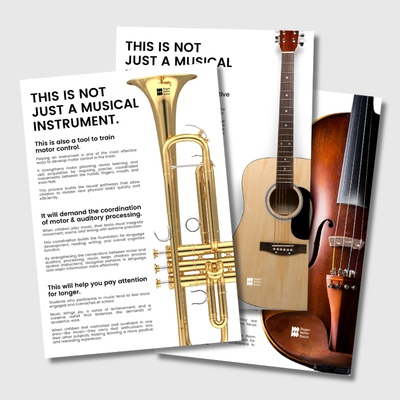

Help students manage school stress through music learning
A practical toolkit that helps music teachers show students how music-making can support stress management, motivation and wellbeing during exams, assessments and other demanding school periods.
When exam season arrives, music rehearsals and practice are often the first things students put on hold. With assignments, revision and academic pressure building, music can start to feel like something they simply don't have time for.
But what if music-making could be part of how students manage that pressure?
The School Stress Toolkit gives music teachers ready-to-use, research-informed resources to help students understand the connection between music learning, the brain and stress. From stress regulation and motivation to social connection and cognitive engagement, the toolkit explores why continuing to make music can be valuable during demanding academic periods.
Use these resources to start conversations, advocate for the importance of music learning and encourage students to keep music part of their study routines.
WHAT YOU GET
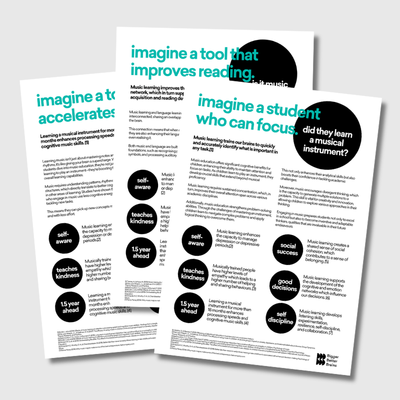
10 Music Learning Helps School Stress Shareable Images + Printer-Friendly Versions – ready-to-share advocacy messages highlighting how music learning can support students during stressful school periods. Share them with parents, school leaders and your wider school community.
16 Music Learning Helps School Stress Digital Posters – research-informed visuals exploring how music-making can support stress regulation, motivation, social connection and cognitive engagement. Display them in classrooms, rehearsal spaces or across your school's digital channels.
2-page Tuning Up Our Brain for the Test Teacher Development Resource – explore the science behind how music-making may support stress management and exam preparation, with research to help advocate for keeping students engaged in music during assessment periods.
2-page School Stress Worksheet for Students – a practical reflection activity that helps students identify stress, explore how music-making can support their wellbeing and consider ways to manage academic pressure.
WHAT IT HELPS YOU DO
Help students understand how music-making can support stress management
Explain the science behind music learning, cortisol and the body's stress response
Explore how musical achievement engages the brain's reward and motivation systems
Highlight the benefits of group music-making for social connection and wellbeing
Encourage students to keep music part of their study routines during exam season
Start meaningful conversations about stress, wellbeing and academic pressure
Give students opportunities to reflect on their stress and explore practical strategies
Advocate for the value of music rehearsals and lessons during assessment periods
Share research-informed messages with parents, teachers and school leaders
Reinforce that music learning can be part of managing school stress, not simply another commitment competing with study
HOW TO USE IT
Bring the science of music and stress into your classroom, rehearsals and school community.
Use the digital posters and shareable images to start conversations about how music-making can support students during stressful academic periods. Display them around your school, share them through newsletters or use them to advocate for continued participation in music learning.
Explore the Tuning Up Our Brain for the Test resource to strengthen your understanding of the research and help explain why attending music rehearsals can be valuable during exam season.
Then, introduce the School Stress Worksheet for Students to encourage students to reflect on how they're feeling, recognise their stress responses and consider how music-making could fit into their own stress-management routines.
WHY IT WORKS
During exam season, students often feel they need to spend every available moment studying. But managing academic pressure involves more than simply increasing study time.
Research suggests music-making can support several processes involved in managing stress and maintaining wellbeing.
Enjoyable musical activities may help regulate the body's stress response, while musical achievement engages brain networks associated with reward and motivation. Group music-making can also strengthen social bonds and feelings of belonging, offering valuable opportunities for connection during demanding school periods.
By understanding these benefits, students can begin to see music learning differently, not simply as another activity on their schedule, but as something that may support them through academic challenges.
Exam season doesn't have to mean putting music learning on hold.
COMMON QUESTIONS
What is the School Stress Toolkit? It's a collection of research-informed digital resources designed to help music teachers explain how music learning can support students during stressful school periods.
Who is this toolkit for? Music teachers, instrumental teachers, ensemble directors and music education advocates who want to support students and communicate the value of music learning during exams and assessments.
What ages can I use it with? The resources are particularly relevant to secondary school students navigating academic pressure, but many can be adapted for other age groups.
Does music-making reduce stress? Research suggests certain musical activities can support stress regulation, with some studies finding reductions in cortisol. Individual responses vary, and music-making is one potential strategy for managing stress.
How can I use the digital posters? Display them in classrooms and rehearsal spaces, incorporate them into lessons or share them digitally to communicate the science behind music learning and stress.
What is the School Stress Worksheet for Students? It's a 2-page reflection resource that helps students recognise their stress, explore how music-making may support their wellbeing and consider practical stress-management strategies.
Can I share resources with parents and school leaders? Yes. The toolkit includes 10 shareable advocacy images with printer-friendly versions to help communicate the value of music learning throughout your school community.
Is this a digital product? Yes. The toolkit is an instant download with digital and printer-friendly resources.
Add to cart NOW. Help students discover why music learning matters, especially during exam season.
LOVE THIS TOOLKIT? GET A BRAND-NEW ONE EVERY MONTH
This toolkit is $50 on its own. BBB+ Premium Toolkit and Premium Annual members receive a brand-new toolkit straight to their inbox free every month, plus access to over 500 evidence-based resources.
Join as a Premium Toolkit member for $60 a year, just $5 a month, and get a new toolkit every month plus the full resource library. That is less than the cost of two standalone toolkits for a whole year of support.
Want everything BBB+ offers? Premium Annual is 50% off right now.
Become a BBB+ Premium Toolkit member today CLICK HERE
Get 50% off Premium Annual CLICK HERE