

Research Updates

Here at Bigger Better Brains we believe that through educating yourself, you can then educate and affect positive change in your community.
With all of the research in the field of neuromusical science, our BBB Research section serves as a content hub for you. We regularly share findings and break down the latest research to educate and inspire discussion. We hope you enjoy this page on our website and share BBB news with your colleagues, parents and students.

Support Student Curiosity Anytime, Anywhere.
Founder of Bigger Better Brains, Dr Anita Collins, receives hundreds of emails from students around the world asking questions about neuromusical research. So she decided to record a short video about the most asked questions she has received.

When Music Makes the Grades
A 2020 study from Brazil found that kids aged 8–12 who joined twice-weekly group music sessions outperformed their peers in reading, writing, and math. They also showed better attention and memory. Led by Projeto Guri, the program proves what many music educators feel: consistent, inclusive music-making fuels broader learning.

What’s getting in the way of recruitment in 2025?
Recruitment in 2025 is about more than filling seats—it’s about consistently advocating for music learning as essential to student growth and wellbeing. Families want to see the long-term value, and students need connection and purpose. Ongoing, intentional messaging leads to stronger recruitment, stability, and lasting impact.

Music Isn’t a Break from Learning—It’s the Launchpad
Music isn’t just an artform—it’s a brain booster. This post explores how music primes the brain for learning by enhancing focus, memory, and emotional connection. For music teachers, it’s a reminder that every lesson is more than musical—it’s neurological.

What if the key to music practice isn’t discipline, but autonomy?
Practice works best when it feels like play.
This article explores what really motivates kids to practise music—highlighting the power of choice, enjoyment, and small wins over pressure or routine. A must-read for music educators rethinking how we support practice.

How Music Unites Us: The Heartbeat Connection
A recent study from Waseda University has uncovered that when individuals listen to music, their heart rates synchronize, reflecting a unified physiological response.
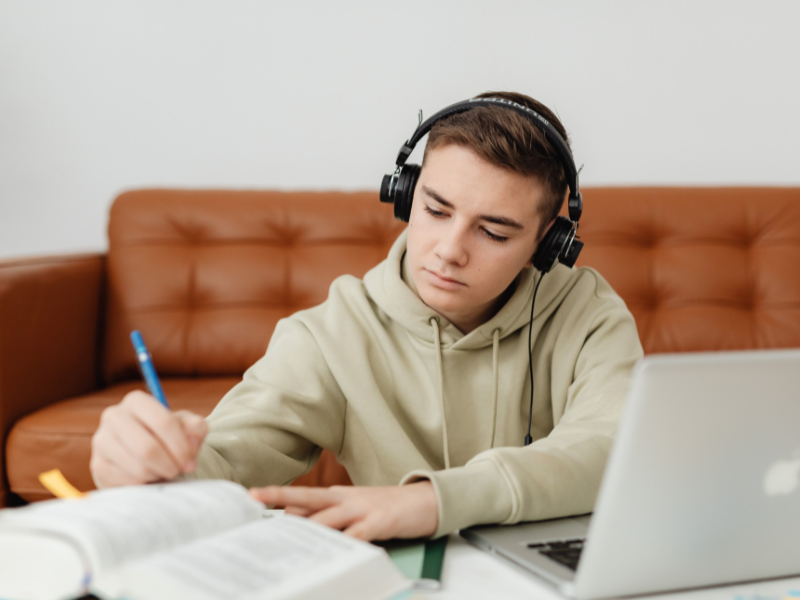
Top 7 questions asked by students
Founder of Bigger Better Brains, Dr Anita Collins, receives hundreds of emails from students around the world asking questions about neuromusical research. So she decided to record a short video about the most asked questions she has received.

How Music Primes the Brain for Learning
This article delves into the transformative impact of music education, particularly for underserved students, and a strategic tool for addressing academic challenges, boosting attendance, language skills, and social integration.

Musical tastes can predict personality traits and political leaning
Do you have similar musical tastes to your friends? How about your work colleagues? Do you think musical tastes tell us anything else about a person? This study thinks it might when it compared musical taste with political leaning.

Would you want to know your musical potential?
Here is one hell of a tricky question – if your musical potential, meaning your likelihood of being successful at learning music (whatever that really means) could be measured, would you want to know?
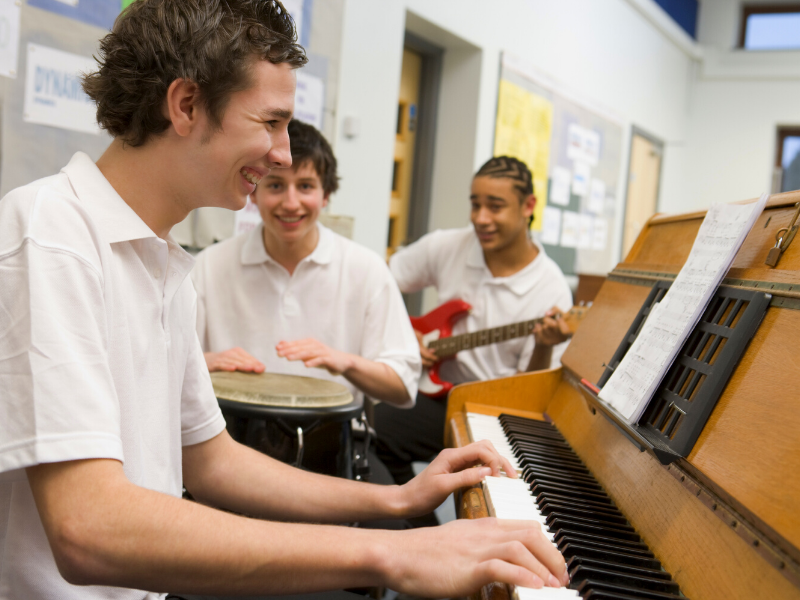
Challenge your brain with different music!
This study looks at how our brains engaged with familiar and unfamiliar music. Turns out our brains sustains engagement with music that is unfamiliar.

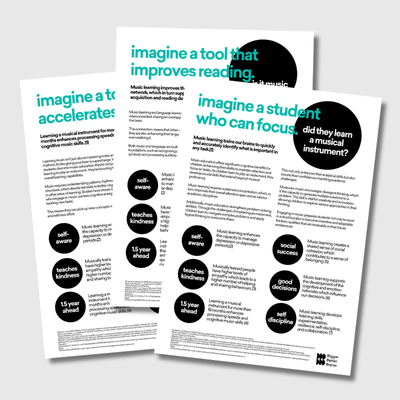
Active Music Learning Infographic
Does all music learning enhance brain development? This is an important question as we examine the research around the impact of music learning on the brain.



The evidence behind everything you teach, in one book
From Dr Anita Collins, music educator and creator of the TED-Ed video watched 17+ million times, translating the world's neuroscience research into the case for music education and the strategies to bring it into your teaching.
You already know music changes your students. The Music Advantage gives you the research that proves it. Because Anita explains the science through real-life stories, it reads like a good conversation rather than a textbook. Use it to advocate for your program, win over parents and leadership, and sharpen what you do in the classroom.
WHAT YOU GET
The complete book, 260 pages
Easy to read: the neuroscience explained through real classroom and family stories
Practical strategies you can apply across any age you teach, from birth to the teenage years
CHOOSE YOUR EDITION
Global edition: for readers outside the US
US edition: US terminology and examples
Signed copy: personally signed by Dr Anita Collins [while stocks last]
HOW TEACHERS USE IT
Advocacy: make the evidence-based case to school leadership for funding and keeping your program
Parent conversations: answer "is it really worth it?" with authority at enrolment and parent nights
In the classroom: practical strategies, from clapping to help a struggling reader, to ensemble play for concentration and social skills
Professional development: deepen your grasp of the "why" behind your teaching, or read it as a department
WHY IT WORKS
Written by Dr Anita Collins and grounded in research from leading neuromusical scientists worldwide, so when you make the case for music you are standing on the science, not opinion. And the real-life stories mean you will actually enjoy reading it.
"This book is my bible. I have so many highlights and pages flagged that I can use with parents and for quotes in emails." Kirsten, Music Teacher.
COMMON QUESTIONS
Which edition should I choose? Global for outside the US, US edition for US spelling and examples.
Is it a hard read? Not at all. Anita uses real-life stories to make the science clear and enjoyable.
What ages does it cover? Birth to the 18 years, useful whatever level you teach.
Add to cart NOW. Put the evidence for music behind your program today.
KEEP THE ADVOCACY GOING
BBB+ gives music teachers everything they need to make the case for music all year round:
A new advocacy toolkit every month
A library of 500+ tools and resources
Exclusive student exercises and advocacy materials
Member discounts
See what members get HERE