

Research Updates

Here at Bigger Better Brains we believe that through educating yourself, you can then educate and affect positive change in your community.
With all of the research in the field of neuromusical science, our BBB Research section serves as a content hub for you. We regularly share findings and break down the latest research to educate and inspire discussion. We hope you enjoy this page on our website and share BBB news with your colleagues, parents and students.

How playing the drums changes the brain
In this recent study, drummers were researched because “Most people can only perform fine motor tasks with one hand and have problems playing different rhythms with both hands at the same time,” but, “Drummers can do things that are impossible for untrained people.”

What happens when one twin practises and the other doesn’t?
Talk about a great experiment. Researchers in Sweden surveyed 83 sets of monozygotic (identical) twins to find 10 pairs who fit the following criteria – only one sibling in each pair currently played a keyboard instrument (piano, organ, keyboard) and within the pair, a difference in total hours of music practice was at least 1000 hours.
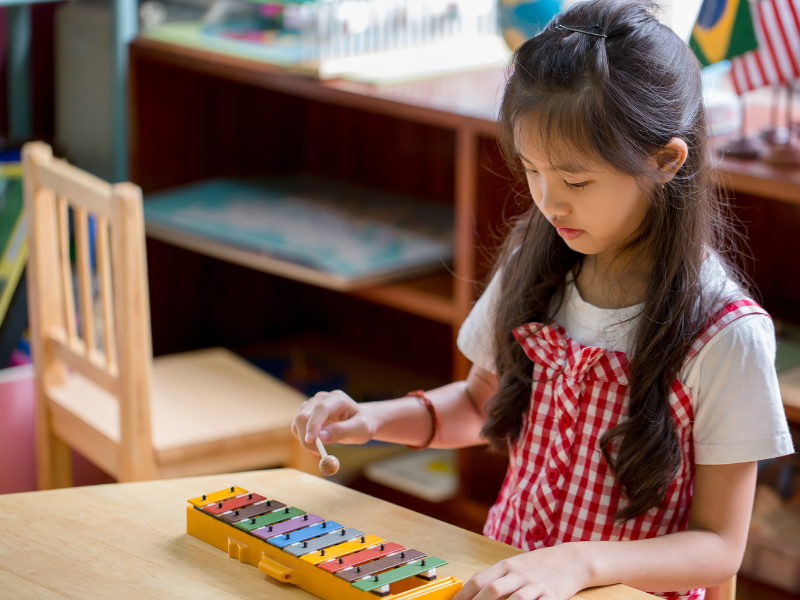
Music Learning Helps Learning Difficulties
The ‘Music Learning Helps Learning Difficulties’ series consists of three information documents to provide you with the research behind how music learning helps a particular area of learning.

Why studying music and the brain is so fascinating, and so difficult
Studying how the brain processes music and how music changes the brain has fascinated neuroscientists for almost 30 years. But these two types of studies, how the brain processes music and how music changes the brain, are also very difficult.

What makes a musical prodigy?
Is it nature or nurture? Is it biological, magic or a quirk?

It is never too late to start learning piano
Research into music learning has found that, while it is a great activity for physical, cognitive, emotional and social development during childhood, it can be just as impactful to learn a musical instrument when we are adults.

Challenge your brain with different music!
This study looks at how our brains engaged with familiar and unfamiliar music. Turns out our brains sustains engagement with music that is unfamiliar.

Music is a neurobiological reward!
The reward network in our brains is one of the most fascinating areas of the brain. It is often the underlying network that propels our behaviour as well as override our good judgement. It is also one of the key networks in learning.

Music synchronises our brain!
There is a theory called the theory of familiarity in music. It is, as described at the end of this article, the idea of an inverted U.

Being musical is part of our human design
In today’s world, filled with myriad parenting methods and high-tech toys that promise to enhance infant development, it is easy to overlook how fundamental the time-honoured practice of music is for all children—starting pre-birth.

Everything in moderation, including syncopation and harmony
This new research looks at the emotive factors in music and uses an idea called the “inverted U”.

Where does perfect pitch come from?
There is a great deal of debate around this question. In the research, the term Absolute Pitch (AP) is used for the more common term of perfect pitch. This recent study points to a stronger genetic link than previously thought.




Help students turn struggle into progress
A practical toolkit that helps music teachers show students what to do when learning gets hard, so getting stuck becomes part of the learning process rather than a reason to stop.
Learning music is full of moments when things don’t work straight away. A note won’t sound right, a rhythm won’t settle, or something that worked yesterday suddenly feels difficult today.
The Productive Struggle Toolkit gives teachers, students and parents practical strategies for navigating these moments. Students learn to stay with a challenge, notice what happened, change their approach, try again and know when to come back later — building a process they can use whenever they get stuck.
WHAT YOU GET
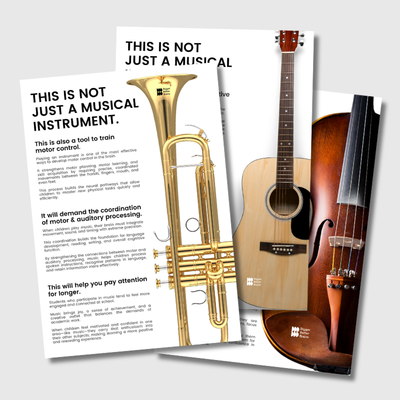
19-page Productive Struggle Book – practical guidance to help you understand productive struggle and teach students how to work through difficult learning moments.
1 Six Habits for Students Poster – a visual reminder of the productive struggle cycle and what students can do when they get stuck.
1 Printable Handout for Instrumental Teachers – practical prompts and strategies to use when students are struggling during lessons.
4 Printable Parent Handouts – help families support productive struggle at home, with practical language they can use during music practice.
7 Printable Music Learning Habits Cards – quick, student-friendly strategies students can reach for when they don’t know what to try next, including narrowing their attention, making a challenge smaller, changing their approach and slowing things down.
WHAT IT HELPS YOU DO
Give students practical strategies for what to do when they get stuck
Turn mistakes and difficult moments into opportunities for learning
Help students notice what happened before simply trying again
Teach students to make challenges smaller and more manageable
Encourage students to change their approach when something isn’t working
Build more purposeful practice habits
Give parents practical language to support music practice at home
Help students recognise that getting stuck doesn’t mean learning has stopped
HOW TO USE IT
Introduce the six Productive Struggle habits to your students, then bring them into everyday lessons and practice.
When a student gets stuck, use the prompts and activities to help them notice what happened, choose a change, test it and decide what to do next. Keep the Music Learning Habits Cards nearby so students can choose a strategy themselves, and share the parent handouts to extend the same language into home practice.
WHY IT WORKS
Students don’t just need encouragement to “keep trying.” They need strategies for how to keep learning when something feels difficult.
Productive struggle teaches students that difficulty is a normal part of music learning. Instead of repeating the same attempt or seeing being stuck as failure, students learn to notice, adjust, test and keep moving forward.
Stuck isn’t stopped. It’s about finding your next move.
COMMON QUESTIONS
What is productive struggle? It’s helping students learn how to respond when something is difficult rather than immediately giving up or relying on someone else to solve it.
Who is this toolkit for? Music teachers, instrumental teachers and parents who want practical ways to support students through challenging learning moments.
What ages can I use it with? The strategies can be adapted across different ages and stages of music learning.
How do I use the Music Learning Habits Cards? Keep them accessible during lessons or practice and encourage students to choose a card when they’re stuck. Each gives them a simple action or question to help them find their next move.
Can I share resources with parents? Yes. The toolkit includes four printable parent handouts designed to help families support productive struggle during music practice.
Is this a digital product? Yes. The toolkit is an instant download with printable resources.
Add to cart NOW. Give your students the tools to know what to do when learning gets hard.
LOVE THIS TOOLKIT? GET A BRAND-NEW ONE EVERY MONTH
This toolkit is $50 on its own. BBB+ Premium Toolkit and Premium Annual members receive a brand-new toolkit straight to their inbox free every month, plus access to over 500 evidence-based resources.
Join as a Premium Toolkit member for $60 a year, just $5 a month, and get a new toolkit every month plus the full resource library. That is less than the cost of two standalone toolkits for a whole year of support.
Want everything BBB+ offers? Premium Annual is 50% off right now.
Become a BBB+ Premium Toolkit member today CLICK HERE
Get 50% off Premium Annual CLICK HERE